

Line planning GUIDE 20
Food filling and capping lines: Assess the product and package together
Compare food filling and capping options through product behaviour, particles, package formats and changeovers. Establish a clear purchase and trial scope.
A food filling and capping line cannot be selected from filling quantity alone. Product behaviour, particle content, container and closure type, product supply and format changes all need assessment. FRUMAK states that its volumetric filling option can handle particulate products, whereas its flowmeter option is not suitable for them. Capping is evaluated according to the closure format. Meaningful comparison uses actual product and package samples within a shared, clearly defined acceptance scenario.
The first question in a filling investment is often how many containers can be filled per hour. That is necessary information, but it cannot select the line on its own. Similar quantities of two products may behave differently, and similar-looking jars may require different closing arrangements.
Moving prepared food into its saleable package is a combined product and packaging project. FRUMAK's filling machine, capping machine and filling line descriptions provide useful starting points for structuring the enquiry.
Describe the product as it reaches the filler
Provide the product's condition during filling, not just its name. Explain whether it is smooth, viscous or particulate, including the actual pieces and any expectation to preserve them. Record which operating conditions the submitted sample represents.
State how prepared product will reach the machine. Existing intermediate containers or transfer equipment may not automatically match the new arrangement. The machine inlet, connecting responsibilities and daily production schedule should therefore be discussed before the quotation scope is fixed.
Compare filling methods through the actual product
FRUMAK describes its volumetric machine as a servo-controlled suction and discharge system performing volumetric filling. It allows for particulate products and identifies piston capacity as relevant to operating limits. Assess the required quantity range together with the real product.
Its flowmeter option is described for flowing and viscous products, with particulate products explicitly excluded. The decision should not rely on general labels such as newer or more advanced. Record which method is proposed for each product and package range.
| Product or requirement | Initial discussion | Detail requiring confirmation |
|---|---|---|
| Particulate product | Discuss the volumetric alternative | Actual particles and package trial |
| Smooth flowing product | Compare the available alternatives | Product behaviour and quantity range |
| Several filling quantities | Request operating limits | Settings and format-change requirements |
| Several recipes | Prepare a product-change scenario | Emptying and cleaning duties |
| New package family | Supply physical samples | Transport, filling opening and closure suitability |
Treat the closure as a separate engineering input
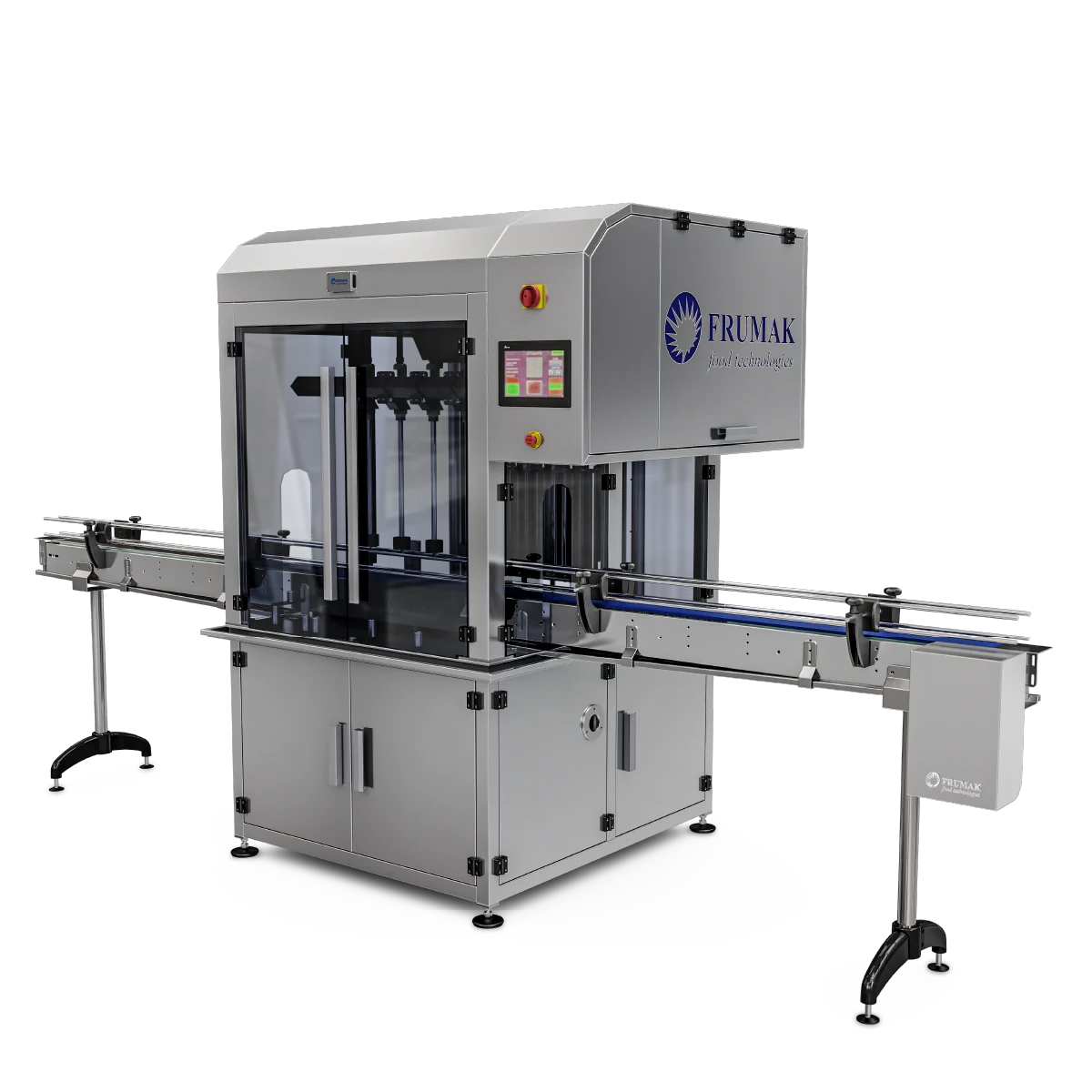
FRUMAK describes different closing methods and project-specific designs for twist-off glass jar closures, plastic bottle caps and pail lids. A quotation stating that capping is included should therefore identify the actual closure formats covered by the proposal.
Supply the container and closure as a matched physical sample. A photograph or nominal volume does not explain all handling and closing details. Include relevant information from the packaging supplier and agree how the proposed closing result will be assessed.
- List matched container and closure formats rather than unrelated items.
- Provide physical samples for every required format.
- Include adjustment and change-part requirements in the quotation.
Examine filling, closing and supply within one working day
A filler operating independently does not demonstrate complete daily line output. Empty-container supply, filled-container movement, closure supply and upstream product transfer must work together. Distinguish manual tasks from the automatic equipment included in the purchase.
Build a day that begins with small jars and changes to larger jars later. Include format adjustment, cleaning and restart. Saleable daily output can then be discussed against a complete workflow rather than only the catalogue's instantaneous speed figure.
Define more than a few successful filled containers
The trial should use the actual product, container and closure within an agreed scope. Identify tested formats, measured results, recording of unsuitable packages and whether changeover is included. Assess findings together with the operating conditions under which they were obtained.
Equipment acceptance does not replace food safety or shelf-life validation. Its purpose is to establish whether the purchased duties have been demonstrated. A product matrix, matched package list, transfer arrangement and example production day give FRUMAK a clear basis for a comparable proposal.
KEY POINTS
Before requesting a quotation
- Assess the filling method against real product behaviour.
- Verify containers and closures as matched formats.
- Compare the complete working day and acceptance scenario, not headline speed alone.
QUESTIONS AND ANSWERS
Frequently asked questions
Is flowmeter filling suitable for foods containing particles?+
FRUMAK's current description says this option is not suitable for particulate products. Its volumetric alternative should be assessed with the actual product and intended package.
Will one capping machine close every type of container?+
That scope should not be assumed. FRUMAK describes different methods and project-specific designs. List every required container and closure pairing explicitly in the quotation.
What should be checked first when comparing line quotations?+
Confirm that they cover the same products, packages, operating period and automation duties. Speed or price alone is insufficient without product supply, closing, format changes and trial scope.
Sources and product information
The following pages document product specifications and equipment scope. Capacity, product suitability and the final supply scope need to be agreed in a project-specific proposal.
Editorial principlesRelated articles
 23
Machine selection 5 min read
How to Choose a Filling Machine: Product, Packaging and Line Output
Select a filling machine around the product, container and finished line output. Compare volumetric and flowmeter options with a practical acceptance checklist.
Cansu Yören 07
Line planning 5 min read
Choosing a honey line around incoming product and packaging
Evaluate honey processing through incoming material, filtration, controlled heating, filling and closure compatibility, with product-based acceptance questions.
Fatih Selvi 15
Line planning 5 min read
Planning a hummus production line: Tahini supply, product texture and filling
Define a hummus line through chickpea preparation, tahini supply, texture and packaging. Separate the verified product scope from future product ideas.
Oğulcan Cağman