

Machine selection GUIDE 22
Choosing a Ball Mill for Spreads: Product Trials and Plant Requirements
Assess a ball mill against your spread recipe, target fineness, capacity and cooling system. Prepare a useful product trial and a comparable equipment enquiry.
Choose a ball mill by defining the finished spread and the evidence needed to accept it. Target fineness, measurement method, feeding conditions and the daily production schedule should be agreed together. Catalogue capacities provide a starting point, while a representative trial establishes how the proposed configuration relates to your recipe. Cooling, product transfer and filling belong in the same assessment. Motor rating alone does not establish product quality or achievable saleable output.
The finished jar of spread reflects several process decisions, not just the performance of the mill. Procurement teams need to understand how the proposed equipment fits the recipe and the rest of the line.
For chocolate and nut-based spreads, review the recipe, incoming material and target fineness together. Establish milling duration and particle-size targets using your own product samples. Record the recipe, sampling point and measurement method for each trial.

1. Define fineness with its measurement method
Terms such as smooth, fine and homogeneous help describe a product, but are insufficient as acceptance criteria on their own. Identify the reference sample, the method of comparison and the point at which the sample will be assessed. Measurements collected under different conditions may not support a meaningful comparison.
For an established product, retain its identity, packaging and production date with the reference sample. For a new formulation, ask the product development team to define the target. Keep sensory assessment and instrument readings as separate records, so a favourable overall impression does not hide an unresolved technical requirement.
- Is there an approved reference sample?
- Who measures fineness, and by which method?
- When after processing will comparisons be made?
2. Describe the material entering the mill
Explain how the incoming mixture is prepared, which ingredients have already been processed and how the mixture reaches the equipment. Agree confidentiality arrangements where necessary, while still providing the information required for an honest suitability assessment.
A successful trial of one spread does not automatically qualify every product in the range. Identify each intended recipe and include the main commercial product alongside a formulation expected to be more demanding. This is a way to structure the evaluation, not a claim about how a particular machine will perform. Record untested recipes separately.
3. Read capacity together with utility requirements
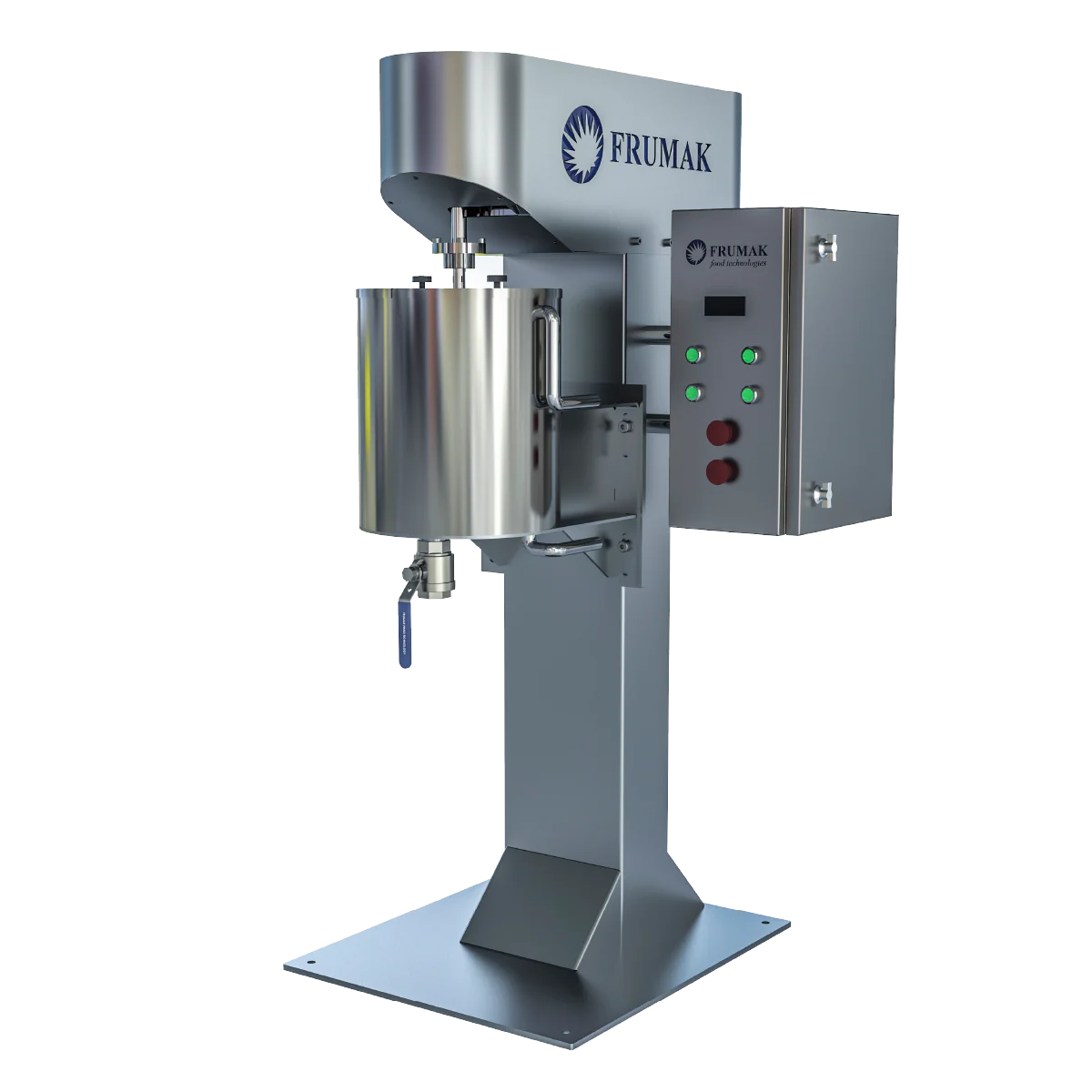
FRUMAK lists FRM.BD8, FRM.BD400 and FRM.BD1000 ball mill models. The technical table uses litres per hour and includes cooling-water information for certain models. Do not substitute kilograms per hour without the relevant product density, and confirm the conditions behind any quoted output.
Cooling-water flow alone is insufficient to select a refrigeration system. Discuss supply and return temperatures, ambient conditions, other consumers on the circuit and the production schedule. Similarly, installed electrical power is not the same as measured energy consumption during a defined process. These distinctions help the site team identify which information is still missing.
4. Separate development work from commercial production
A development machine may be selected primarily to work with small quantities. Commercial production may prioritise the shift schedule, feeding arrangement and transfer to filling. If one purchase is expected to serve both roles, assess the scenarios independently.
| Scenario | Main question | Record to request |
|---|---|---|
| Recipe development | Can the intended small quantity be processed? | Minimum batch and sampling plan |
| Single-product production | Under what conditions is the daily target achievable? | Recipe-specific capacity trial |
| Multiple products | How is the transition managed? | Discharge and changeover record |
| Existing line addition | Do feeding and filling match the process? | Flow and buffer assessment |
| New factory | Who supplies cooling and site connections? | Utility responsibility schedule |
5. Obtain a documented process, not just a pleasing sample
Record the raw-material batch, mixture quantity, initial conditions, sampling times and final evaluation. When a sample is accepted, identify the observations and measurements supporting that decision. This makes the purchase traceable to a defined trial rather than to an unlabelled jar.
Ask about product-contact components, access for maintenance and the assumptions behind any recommended spare-parts list. FRUMAK's spread-production page introduces several product families; your quotation should identify which are included in the proposed scope and which configuration will be used. Explicit exclusions are more useful than an unsupported assumption that every future recipe is covered.
KEY POINTS
Before requesting a quotation
- Specify the target product and measurement method before comparing equipment.
- Assess cooling through flow, temperature and simultaneous demand.
- Link trial results to the delivered configuration and named recipe range.
QUESTIONS AND ANSWERS
Frequently asked questions
Is there one ideal particle-size target for every spread?+
No universal target should be assumed in procurement. Define the requirement for the intended product, together with the reference sample, measurement method and assessment conditions.
Can a litres-per-hour catalogue value be treated as kilograms per hour?+
No. Conversion requires the density of the relevant product. The supplier should also confirm which material and operating conditions the published capacity describes.
How can I assess my existing cooling system?+
Provide its flow, temperature and available capacity information. Evaluate the mill alongside other simultaneous consumers, rather than relying on a single flow figure in a catalogue.
Sources and product information
The following pages document product specifications and equipment scope. Capacity, product suitability and the final supply scope need to be agreed in a project-specific proposal.
Editorial principlesRelated articles
 03
Process & product 5 min read
Defining a chocolate and spreadable cream production project
Plan a spreadable cream line around product scope, refining requirements, recipe changes and packaging rather than treating all chocolate applications alike.
Oğulcan Cağman 29
Investment guides 6 min read
Choosing a Food Machinery Supplier: An Evidence-Based Checklist
Compare food machinery suppliers through product trials, technical scope, service and handover records. Use a neutral checklist to evaluate equivalent offers.
Cansu Yören30Investment guides 5 min read
Pilot Trials, FAT and SAT: Planning Production Line Acceptance
Give pilot trials, factory acceptance and site acceptance distinct objectives. Plan product samples, measurements, open items and handover records before testing.
Oğulcan Cağman