

Process & product GUIDE 11
Choosing a sauce production line: From recipe requirements to filling
Plan a sauce production line around product texture, process duties, particles and packaging. Build a clear specification before comparing equipment.
Choosing a sauce production line starts with the product specification, rather than the sauce name. Texture, visible particles, processing sequence, batch schedule and packaging all affect the equipment discussion. A smooth sauce and a sauce containing pieces may require different preparation and filling decisions. Representative product samples help connect the mixing duties, transfer arrangement and filling method. The resulting specification should describe what each part of the line must do and how that performance will be assessed.
Manufacturers often begin a project by asking for one line that can produce several sauces. That can be a useful objective, but the product list must explain the differences between recipes. Otherwise, flexibility remains an undefined expectation.
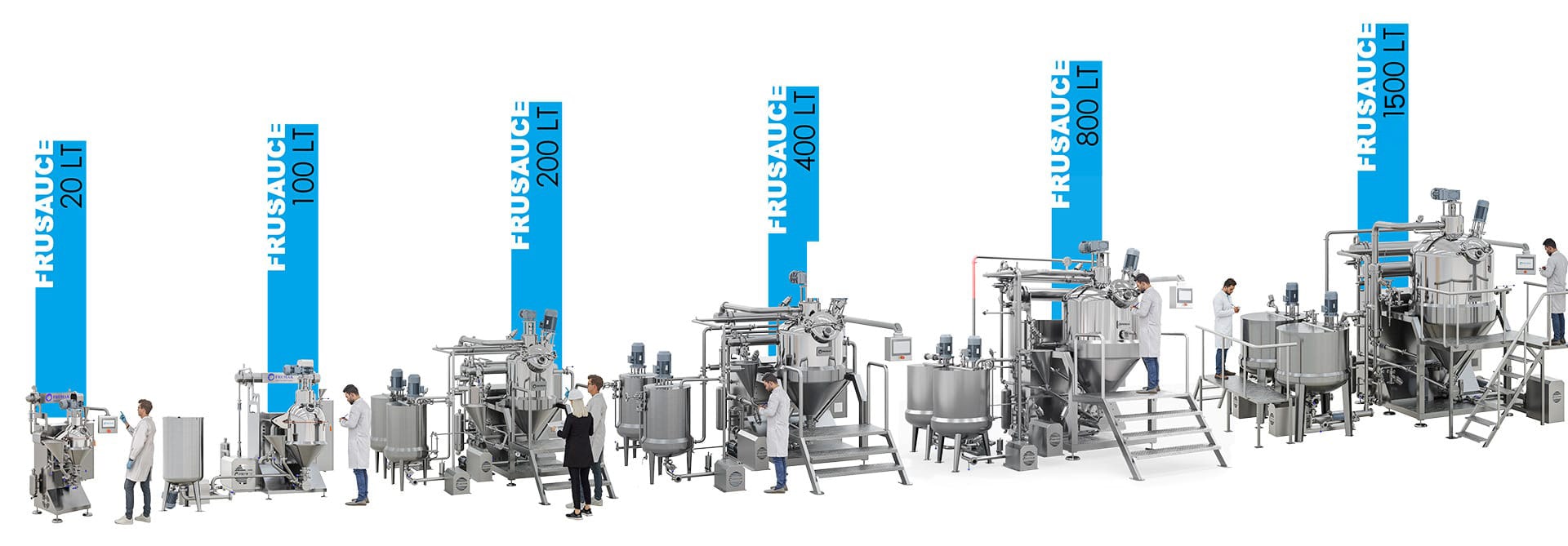
FRUMAK describes hot and cold processing approaches on its sauce line page. Its sauce process unit combines functions including mixing, heating, cooling and homogenisation. The presence of these functions does not mean that every recipe will use the same sequence or settings.
Turn the product range into a practical matrix
List the target texture, particle content, packaging format and production frequency for each sauce. A product intended to remain visibly textured should not be described only as another thick sauce. The requirement to distribute ingredients and the requirement to preserve pieces are separate questions.
Attach representative finished product samples to this matrix. Record the conditions under which their behaviour is assessed. If the product behaves differently during preparation and when it reaches the filler, both states belong in the project information.
- Match each product sample to its intended package.
- Describe particle size and the expectation to retain pieces.
- State batch sizes and product changes, as well as daily output.
Specify processing duties before selecting a sequence
A commercial sauce name does not establish its complete process. Describe the required duties separately: ingredient distribution, mixing, heating, cooling, homogenisation or removal of entrained air. The product development team should connect these duties to the intended recipe and finished product specification.
FRUMAK's hot and cold process distinction provides a starting point for that discussion. Temperatures, holding periods and product safety acceptance criteria must come from the manufacturer's validated development work. They should not be taken from a general equipment article.
Assess preparation and filling together
A suitable preparation unit does not automatically establish the suitability of a filler. FRUMAK states that its volumetric option can handle products containing particles, while its flowmeter option is not suitable for particulate products. The actual product and package still need assessment.
| Product situation | Main question | Evidence to request |
|---|---|---|
| Smooth sauce | Which processing sequence delivers the target texture? | A sample-based process proposal |
| Sauce with pieces | Will transfer and filling preserve the intended pieces? | Trials using the actual product |
| Several recipes | How will product changes be completed? | Defined emptying and cleaning duties |
| Several packages | What changes between formats? | A package-specific format list |
Make the route between vessel and filler visible
Layout discussions often focus on the largest machines. The route taken by the prepared sauce deserves equal attention. Identify transfer connections, any intermediate holding arrangement, residual product management and access for cleaning. These details influence the practical daily schedule.
Consider a day with one sauce in the morning and a different sauce in two package sizes during the afternoon. The project question is not simply filling speed. The specification should explain what happens in the preparation vessel, transfer path and filler during each change.
Tie the purchase decision to a defined product trial
Before comparing prices, establish whether quotations include the same preparation, transfer, filling, closing and utility connections. Training and commissioning responsibilities should also be visible. A lower total may reflect a smaller scope rather than a more economical complete line.
Prepare a trial file containing the recipe version, representative samples, package formats and agreed observations. Acceptance should demonstrate the intended product through the agreed workflow. A running machine alone does not show that the product specification or changeover requirements have been met.
KEY POINTS
Before requesting a quotation
- Describe product behaviour before choosing equipment.
- Use the same representative samples to assess preparation and filling.
- Include product changes and acceptance trials in the purchase scope.
QUESTIONS AND ANSWERS
Frequently asked questions
Can one sauce line handle several recipes?+
It can be evaluated where the requirements overlap. Suitability must be checked against product samples, particle characteristics, cleaning changes and packaging formats. A list of sauce names is not sufficient evidence.
Is flowmeter filling suitable for sauces containing pieces?+
FRUMAK's current description states that its flowmeter option is not suitable for particulate products. The volumetric alternative should be assessed with the actual particles and intended package.
What should be sent with an initial enquiry?+
Provide the product matrix, representative samples, batch schedule and packaging examples. Add the available layout, utility information and expected product changes to define the quotation boundaries.
Sources and product information
The following pages document product specifications and equipment scope. Capacity, product suitability and the final supply scope need to be agreed in a project-specific proposal.
Editorial principlesRelated articles
 19
Line planning 5 min read
Planning a cosmetic process line: From visual concept to verified scope
Plan a cosmetic process line through formulation, contact materials, cleaning and packaging. Distinguish a visual concept from verified suitability.
Fatih Selvi 03
Process & product 5 min read
Defining a chocolate and spreadable cream production project
Plan a spreadable cream line around product scope, refining requirements, recipe changes and packaging rather than treating all chocolate applications alike.
Oğulcan Cağman 14
Process & product 5 min read
Ajvar and vegetable roasting lines: Connecting preparation, texture and filling
Plan an ajvar line by connecting vegetable roasting, skin removal, target texture and filling. Use real product and package samples to define scope.
Cansu Yören