

Line planning GUIDE 10
Paste production planning: Fresh tomatoes and peppers versus re-pack
Separate fresh tomato, pepper and re-pack paste projects, then define preparation, concentration, filling, seasonal capacity and utility requirements clearly.
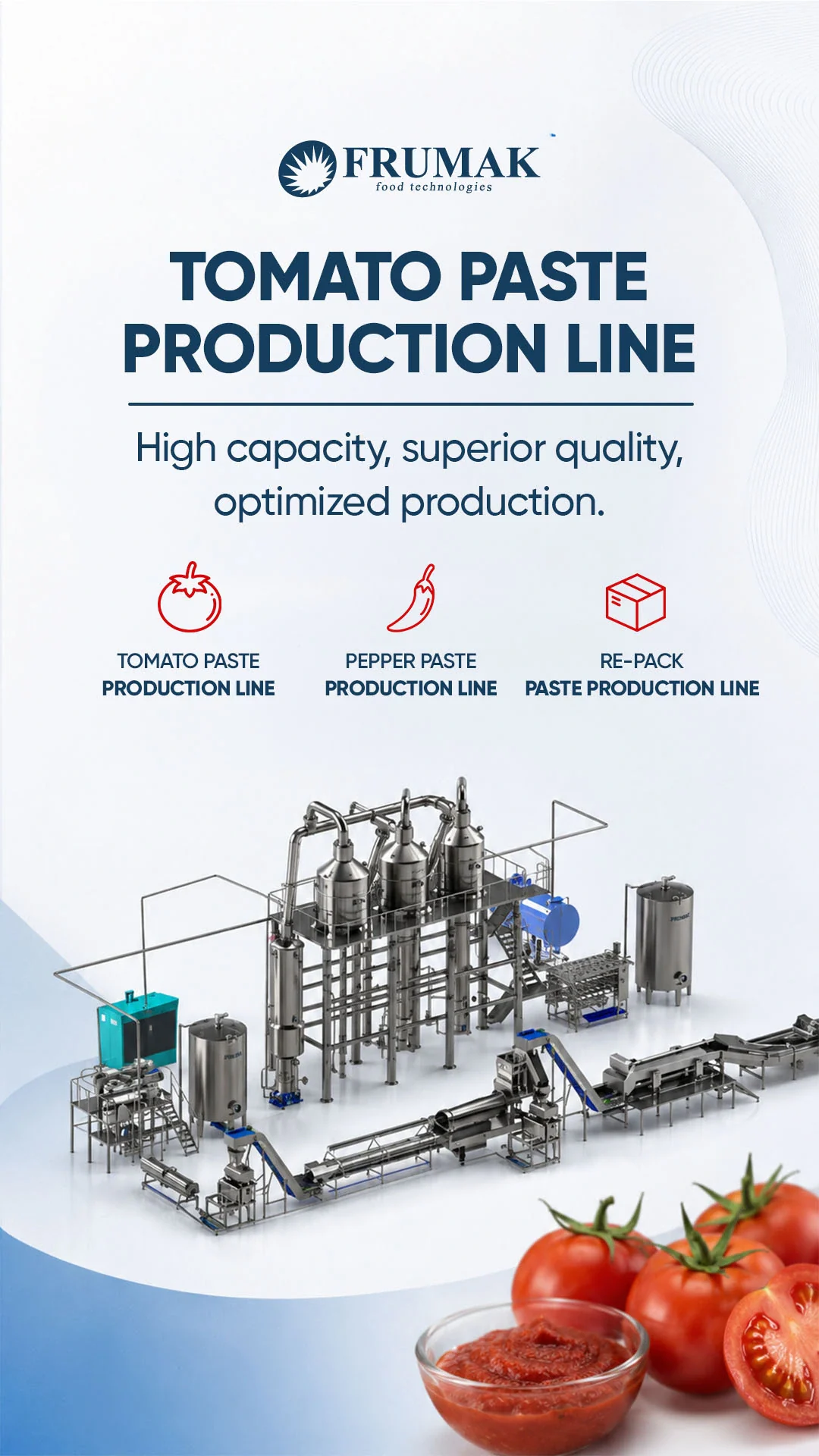
The first distinction in a paste production project is whether the factory will process fresh tomatoes or peppers, or repackage existing paste. These starting points require different equipment scopes. FRUMAK presents tomato, pepper and re-pack options separately. Preparation, concentration, transfer and filling should be evaluated from the selected boundary. Incoming raw material capacity must also be distinguished from the quantity of saleable finished paste when comparing proposals.
Two buyers asking for a paste factory may mean very different investments. One intends to receive fresh tomatoes during the season; another wants to transfer existing paste into retail packs. Comparing those projects only by equipment price hides the actual scope difference.
Define the incoming material, the operations to be performed on site and the intended packaging. Fresh tomatoes, peppers and prepared paste require different preparation stages. Formulation, processing temperature and shelf-life conditions must be validated for the intended product before the equipment scope is agreed.
Separate fresh raw material from re-pack
Fresh tomato or pepper processing begins with preparing the incoming crop. FRUMAK describes re-pack as processing double-concentrated paste supplied in aseptic drums: adjusting it to the required Brix, pasteurising it and filling the selected packaging. The scope therefore extends beyond simply changing containers. Do not assume a re-pack project needs the complete fresh-product preparation section, or that a filler alone covers production from fresh tomatoes. State the incoming product at the beginning of the brief.
If a business plans fresh-product manufacturing for part of the year and re-pack at other times, show how the routes connect. Identify shared equipment, different feeding points and product changes. Each starting route needs a defined acceptance condition, not simply another product name in the quotation.
| Starting scenario | Priority scope | Question to resolve |
|---|---|---|
| Fresh tomatoes | Preparation and subsequent processing | Incoming material, preparation boundary and target paste |
| Fresh peppers | Pepper-specific preparation and processing | Equipment differences from the tomato route |
| Re-pack paste | Concentrated paste from aseptic drums; target Brix adjustment, pasteurisation and filling | Incoming container, target Brix and process-to-filling scope |
| Combined operation | Compatible shared equipment | Connection points and changeover scenario |
Evaluate concentration under defined production conditions
FRUMAK describes its compression evaporator in terms of removing water to increase concentration and reusing the generated vapour. It associates the equipment particularly with paste processing. The machine name does not establish identical finished output or energy performance for every feed product.
Define the product entering the evaporator, target outlet and operating conditions for evaluation. Include utilities and connection points. Do not convert an ambiguous catalogue capacity into an hourly production or savings claim without confirming the unit and context. The engineering assessment must use defined inlet and outlet conditions.
Build the seasonal plan around the complete line
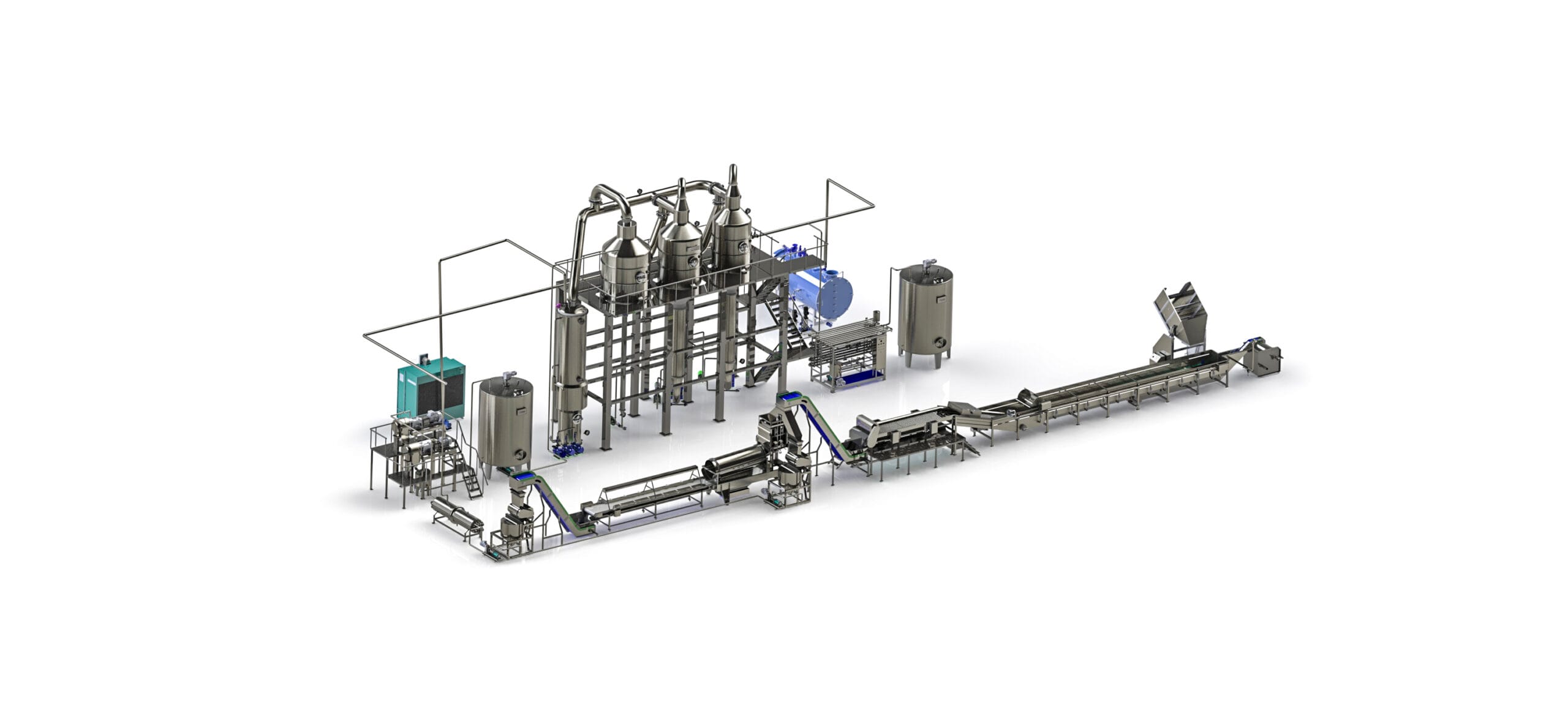
Fresh-product factories need to explain when raw material arrives and when it will be processed. Concentrated seasonal operation and a more distributed production schedule create different operating scenarios. Review receiving, preparation, concentration and filling together on an example schedule.
Incoming crop quantity and saleable paste quantity are different figures. Separation and concentration mean they describe different process points. Write down where each quoted capacity is measured. This enables comparison against the same production duty instead of relying on a tonnage that may refer to a different part of another supplier's scope.
Bring actual paste and packaging to the filling discussion
Filling needs to be reviewed with actual product characteristics and the intended package. FRUMAK describes volumetric and flowmeter alternatives, which do not have identical application boundaries. Nozzle count alone is not an adequate selection method without the product and packaging samples.
Include closing and downstream handling in the proposal boundary. Discuss adjustments, change parts and upstream response during packaging changes. For re-pack, explicitly identify responsibility for emptying the incoming container and preparing product for filling. Focusing only on the retail jar can leave the beginning of the project undefined.
Test utilities and changeovers against the seasonal schedule
Provide existing steam, electricity, water and other relevant services before finalising concentration and filling equipment. Define the interface between building services and the supplied machinery. Values from one machine's data table must not be treated as the requirements of another model; project conditions and selected equipment need to be reviewed together.
Where tomatoes and peppers run in different periods, the changeover is more than selecting a recipe. Preparation suitability, residual material, cleaning and filling adjustments all need discussion. Build an activity list around the planned product sequence instead of requesting an unsupported universal cleaning duration.
Request capacities at named points such as fresh tomato input, evaporator feed or paste ready for filling. In re-pack operation, incoming containers and the transfer arrangement become particularly important. A single numerical rating should not be treated as proof of the entire investment's output without defined material and product conditions.
Compare proposals with equivalent scope and acceptance
Check that competing proposals start with the same raw material, include equivalent equipment and end at the same point. Review automation, site connections, installation, training and trials separately. A shorter equipment list cannot be judged simply as better value before the missing or different scope is understood.
Prepare the starting route, target paste, packaging, operating calendar and building conditions for the first meeting. Agree trial materials, measurement locations and who evaluates the product. The purchasing decision then rests on a defined manufacturing task rather than general factory promises.
KEY POINTS
Before requesting a quotation
- Define tomato, pepper and re-pack as separate starting scenarios.
- Clarify concentration inlet, outlet and utility requirements.
- Review packaging, seasonal schedules and acceptance together.
QUESTIONS AND ANSWERS
Frequently asked questions
Is re-pack the same as processing fresh tomatoes?+
No. FRUMAK re-pack processes concentrated paste from aseptic drums through adjustment to the target Brix, pasteurisation and filling into the selected packaging. Fresh tomato processing starts with a different raw-material preparation scope.
Can tomato and pepper paste be considered together?+
They can be reviewed within one project, but preparation and processing requirements must be defined for each. Shared and product-specific equipment should be identified.
Does raw material input tonnage equal finished paste output?+
No direct equivalence should be assumed. They represent different process points. Capacity calculations need named measurement locations and defined operating conditions.
Sources and product information
The following pages document product specifications and equipment scope. Capacity, product suitability and the final supply scope need to be agreed in a project-specific proposal.
- FRUMAK Paste Production Line
- FRUMAK Re-Pack Paste Production Line
- FRUMAK Compression Evaporator
- FRUMAK Filling Machine
Related articles
 02
Line planning 5 min read
Choosing a jam and marmalade line starts with the fruit's final form
Compare jam and marmalade lines through fruit form, raw material supply, vacuum cooking, filling compatibility, utilities and realistic product changeovers.
Cansu Yören 07
Line planning 5 min read
Choosing a honey line around incoming product and packaging
Evaluate honey processing through incoming material, filtration, controlled heating, filling and closure compatibility, with product-based acceptance questions.
Fatih Selvi 08
Line planning 5 min read
Plan a fruit juice line from incoming fruit to the finished bottle
Define fruit preparation, pressing, thermal processing and bottling as connected parts of a juice project, with clear product and packaging requirements.
Cansu Yören