

Line planning GUIDE 01
Planning a turnkey food factory: From equipment list to working production
Define your food factory project through product requirements, equipment scope, utilities, layout and acceptance criteria before comparing turnkey proposals.
A turnkey food factory is a coordinated production project, not simply a collection of connected machines. Product requirements, incoming ingredients, packaging, operating schedules and building conditions must be defined together. The most useful starting point is a requirements brief that describes saleable output and acceptance criteria. That brief allows equipment, utilities and the operating team to be planned around the same production scenario.
A factory investment often begins with familiar equipment names: a cooking vessel, a filling machine or a sesame roaster. Those names do not explain how the factory will operate. Where will ingredients enter? Where can product wait? What happens during cleaning or a packaging change? Answering these questions makes the proposed scope understandable before an order is placed.
FRUMAK's jam, spreadable cream and sesame processing ranges illustrate why one standard factory layout cannot describe every food project. The objective is to establish a practical scope for the products you intend to manufacture.

Describe saleable output before selecting capacity
Incoming material and finished product are different measurement points. Fruit preparation may separate unwanted material, while cooking and concentration change the product sent to filling. State the incoming material, target product, packaging and planned varieties separately. If an important requirement remains undecided, identify it rather than allowing an assumed value to enter the quotation.
For example, a factory making strawberry jam in the morning and apricot marmalade later needs an explicit changeover scenario. A list of vessel sizes will not reveal preparation, cleaning or intermediate holding requirements. An example production day gives suppliers a more useful basis for discussion.
Translate turnkey into a responsibility schedule
Do not assume that the word turnkey includes every building connection or service. Process equipment, pipework, electrical panels, site wiring, utility connections and training should be identified individually. Ask who designs, supplies, installs and commissions each item. This makes omissions visible while the project is still being defined.
| Decision area | Question to resolve | Requested document |
|---|---|---|
| Process equipment | Which products and incoming conditions are included? | Process diagram and equipment list |
| Building interfaces | Where does each party's responsibility end? | Connection point drawing |
| Automation | Which recipes, alarms and records are included? | Functional description |
| Commissioning | Who supplies trial ingredients and operators? | Acceptance and training plan |
Review the layout as an operator and a maintenance technician
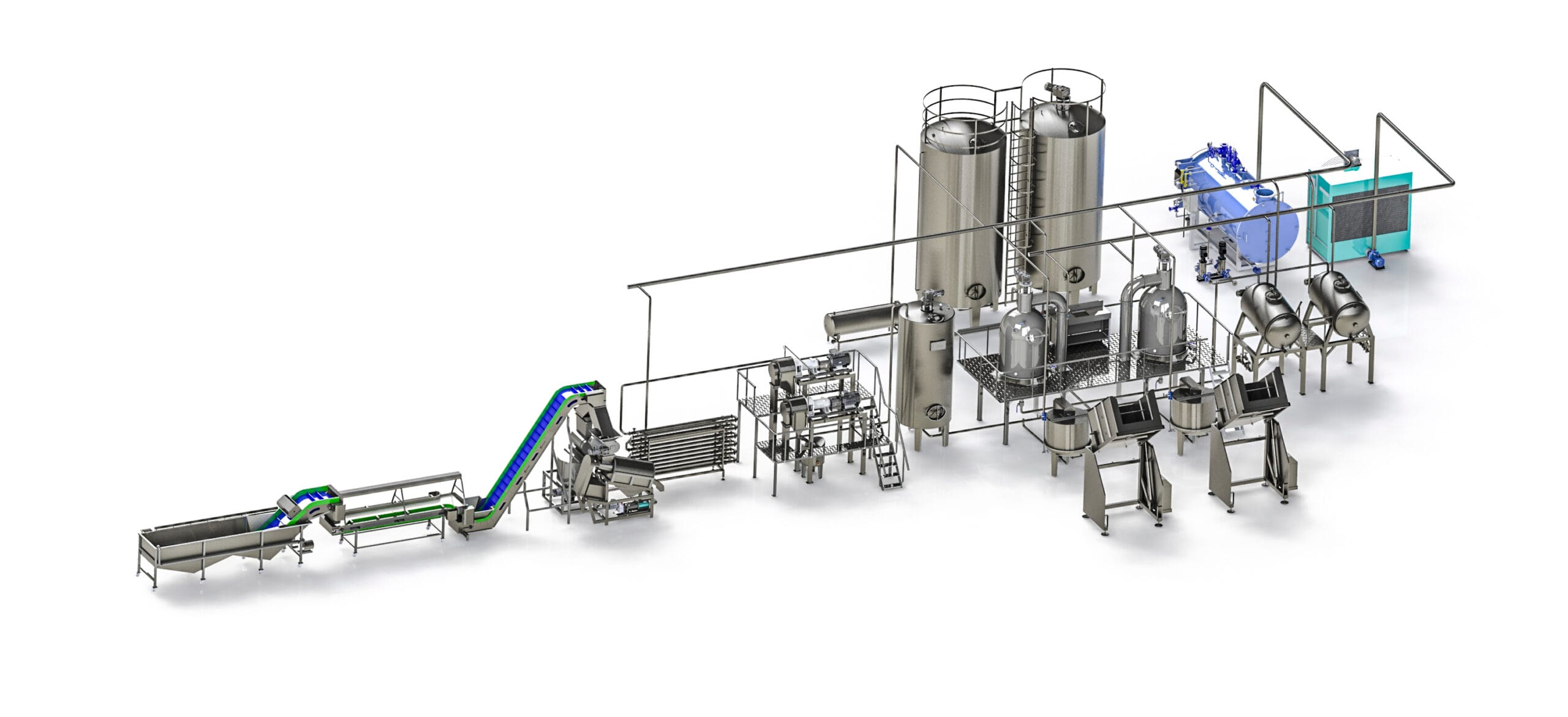
A machine fitting inside a room does not prove that it can be operated comfortably. Packaging replenishment, opening access covers, removing components and moving cleaning equipment all need space. Share ceiling heights, columns, doors and existing services early, especially when equipment must fit an existing building.
Follow one batch from incoming storage to finished goods on the drawing. Then repeat the exercise from the perspective of maintenance staff and packaging supply. These different routes expose questions that an attractive overhead rendering can hide. Final access and hygiene zoning require project-specific engineering review.
Evaluate a balanced line rather than the largest individual machine
Increasing one machine's nominal capacity does not automatically increase factory output. Cooking may finish while filling is still processing the previous product. Continuous equipment may have to communicate with batch equipment. Ask how transfers, temporary holding and downstream interruptions are handled in the proposed operating scenario.
Future expansion also needs a defined purpose. Adding another pack size is different from introducing a different process. Reserved space or a spare connection should be linked to a named future requirement. A drawing that shows the intended expansion is more useful than a general statement that the line is expandable.
Agree acceptance conditions before placing the order
Acceptance planning should identify trial ingredients, packaging, measurement points and the records to be collected. Product targets come from your formulation and quality plan; they cannot be inferred automatically from a machine catalogue. Establish who evaluates the finished product and how that evaluation relates to equipment acceptance.
Include operator training, maintenance documentation, spare parts information and the support contact process. Delivery then becomes more than equipment arriving on site. It connects the supplied system with your team's ability to operate the agreed production scenario. A clear brief makes the first technical discussion considerably more productive.
KEY POINTS
Before requesting a quotation
- Define the product and packaging before finalising the equipment list.
- Record turnkey responsibilities and delivery boundaries in writing.
- Review layout, line balance and acceptance as one project.
QUESTIONS AND ANSWERS
Frequently asked questions
What information should a turnkey factory enquiry contain?+
Provide the product family, incoming material condition, packaging and an example production schedule. Include building drawings, existing utilities and any equipment that the new installation must connect to.
Can one factory process every type of food?+
That should not be assumed. Product behaviour, processing requirements, cleaning and packaging must be reviewed together to define the included product range.
Is the highest catalogue capacity the safest choice?+
Not necessarily. Preparation, processing, transfer, filling and changeovers need to be evaluated as one operating scenario. The interaction between machines matters as much as individual ratings.
Sources and product information
The following pages document product specifications and equipment scope. Capacity, product suitability and the final supply scope need to be agreed in a project-specific proposal.
- FRUMAK Jam and Marmalade Production Line
- FRUMAK Spreadable Cream Production Line
- FRUMAK Sesame, Tahini and Halva Production Line
Related articles
 28
Investment guides 5 min read
Production Line Cost: Compare Quotations on an Equivalent Scope
Compare production line costs beyond the machine price. Align equipment, utilities, installation, acceptance and operating assumptions before choosing a quote.
Fatih Selvi 27
Investment guides 5 min read
Food Factory Layout: Plan Access and Utilities Before Ordering Equipment
Plan food factory layout around product flow, maintenance access, equipment delivery routes and utilities. Prepare a practical site brief before ordering.
Oğulcan Cağman 02
Line planning 5 min read
Choosing a jam and marmalade line starts with the fruit's final form
Compare jam and marmalade lines through fruit form, raw material supply, vacuum cooking, filling compatibility, utilities and realistic product changeovers.
Cansu Yören